>>> (1) In the past a popular theory recommended terminating short radials with a ground stake at the wire’s distal end. (etc)Yes, in general, that's still considered a good precaution. How effective it is depends on a number of factors, though. Reading back through "ancient literature" on the subject, I see it was used in some military VLF installations up into WW II, and was tried at several LowFER stations in the 80s and 90s. The results for LowFERs were generally more significant for installations that either had few ground radials, or else radials that were short relative to the antenna height.
As you may have read in my reply back in late January about the proposed KH beacon, what you are attempting to do with a radial system is to capture and return as much current as possible through the metallic radials with as little as possible through the lossy earth itself. Most of that current will "land" within a radius equal to the antenna height, plus the radius of a modest top hat, plus a small additional fringing factor. (If the top loading is an L or a T with a length greater than the height, then its length that becomes the more relevant length for the radials closest to being beneath the top load arrangement.) For an electrically very short antenna, there's no need to worry much about the negligible current returning from outside that radius. If most of your radials are at least that long, you could expect to see less effect from ground rods than if the radials are shorter.
In general, you want the most possible radials in or on the ground near the base (say, within half the height of the tower), where the return current is greatest, with as many of those as possible running all the way out to the radius previously described. If you can't put very many all the way out to the full height of the tower, though, that's when you might want to try some ground rods at the far ends of the longer wires.
>>> (2) Suppose all the radial wires are made of 2 lengths of wire. [...] Does the ground stake at the junction of wires “x” and “y” buy you anything w.r.t. providing a “better RF ground return?”
"Anything," maybe. Enough to justify the extra work? Probably not in most cases.
One exception might be if you were using the junction of "x" and "y" to connect multiple "y" wires to the junction to form a sort of multiple-star ground system to better collect some of the more distant return current. At left, below, is the basic concept. Ground rods, if you were to use them, might be fairly effective as the hubs of those "stars." In its original application at large VLF military stations, there might only be six stars like the basic configuration shown, but the heavier "wires" were often actually wide copper straps, elevated above the ground. That wouldn't be necessary here.
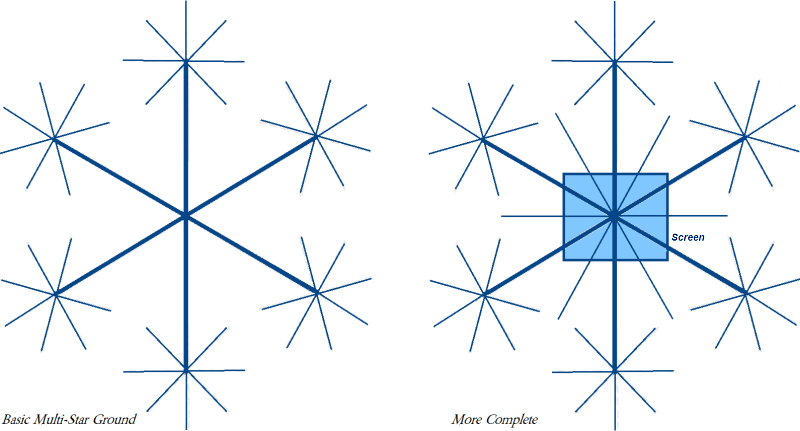
A few modern AM broadcast stations on lower frequencies use a configuration closer to the one at right...but with more stars and more in-between radials than shown here. The higher power ones also use a copper screen in the high current density region. In a LoweFER or Part 5 case, plenty of radials is better and the screen is optional, but chicken wire can take the place of copper screening if such is desired.
>>> (3) Considering the ability of a 160 and 630 meter E/M wave to penetrate the earth’s surface, is there a point of diminishing returns when it comes to ground stake length?
Certainly. The point will vary with both frequency and soil conductivity, though. At 630 meters and with good soil, the skin depth will be shallow, and it may be just as well to forget rods entirely. At 1750 meters or 2200 meters, or at 630 m with poor soil, four foot rods may be enough to provide benefit; or, may not produce much result at all, if there is an adequate number and length of radials already. Eight foot rods are seldom worthwhile, IMO, unless you're just plain stuck with VERY short radials.
If you do use ground stakes, consider enhancing and stabilizing the conductivity of soil around the grounds and radials with Epsom salt. Your lawn will probably love it too.
John
---------------------------------------------------------------
 File Attachment 1: multi-star2.gif