A High-Performance Low Frequency Converterby Tim Brannon, WA5MDMany simple designs for low frequency converters have been published over the years. However, most of these designs used basic single-ended mixers with only fair performance in terms of sensitivity and dynamic range, and this has created the perception that a converter is a "second- rate" method of LF reception. That is unfortunate, because a well-designed converter working into a modern receiver will deliver performance on par with virtually any radio designed for LF. The superhet rigs most of us use today are just one or more converter stages working into a 455 kHz IF. With the widespread availability of high performance general coverage receivers, who needs a converter for LF today? Well, maybe YOU do, and for a couple of reasons. First, if you are using a new general coverage receiver or ham transceiver as your LF rig, check your manual for the specs at LF. As some of us have discovered, just because it tunes down to 100 kHz DOESN'T always mean it can HEAR anything there! A receiver front-end or mixer optimized for HF may just not work very well at LF. My ICOM 738 is basically dead below 300 kHz even though it tunes down to 30 kHz. In many of the ham rigs available today, the receiver includes an automatic 20-30 dB attenuator below 1600 kHz to prevent overload from local AM broadcasters. The sensitivity of some Yaesu rigs improves a bit from 150-500 kHz but remains poor compared to HF. The Kenwood TS-850 appears to be the only current model ham rig offering LF receiver specs comparable to its HF coverage. Another problem with LF coverage in today's radios is internally-generated noise. Several people have commented on this problem with the Watkins- Johnson HF-1000 and its on-board computers. I've heard the same complaint about the Kenwood TS-930, where fluorescent display noise is the culprit. A converter with suitable shielding and isolation of its power supply may help minimize this problem. In the June '77 issue of QST DeMaw and Rusgrove presented a design for a high performance converter based on a doubly-balanced mixer (DBM). -1 This excellent converter was tailored for the LOWFER band, using a 1.7 MHz IF and a 300 kHz low-pass filter ahead of the mixer. Unfortunately, these choices for IF and filter cutoff made it less useful for general LF listening. It also required the builder to make his own DBM, which involved winding two trifilar transformers and sorting through a batch of 1N914 diodes to find a matched set of four, both do-able but tedious tasks. This design is based on that of DeMaw and Rusgrove, and their article is recommended reading. Three basic changes have been made: 1) The front end filter now has a cut-off of 600 kHz, giving full coverage at LF and allowing use of standard value capacitors. 2) The IF is now 4 MHz, so the LF frequency can be read directly from the receiver display. 3) The mixer is now a commercially-available Mini-Circuits SBL-3 DBM, rated to work down to 25 kHz!
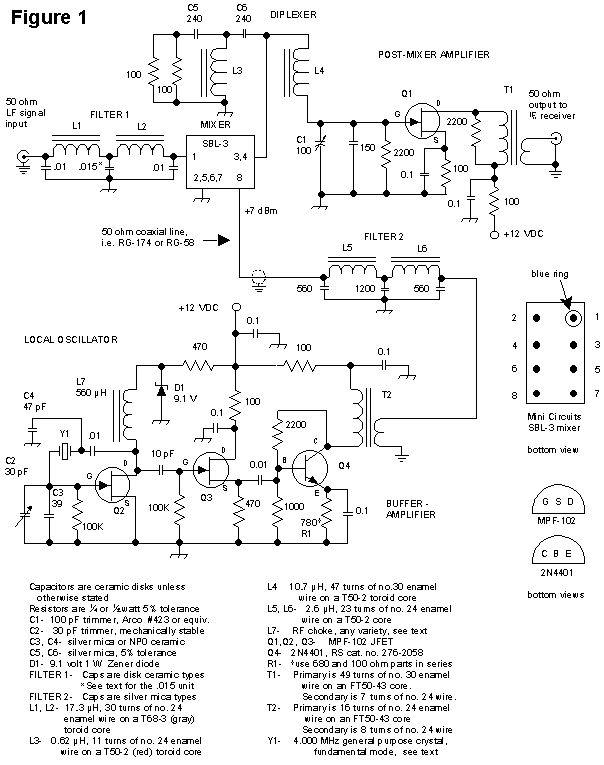
DesignFilter 1 is a 50 ohm Chebyshev low-pass filter with a cut-off of 600 kHz and is designed to attenuate strong broadcast band signals. This frequency was chosen for convenience to allow the use of standard value disk ceramic capacitors in the filter. The mixer is a Mini-Circuits SBL-3 DBM. It is rated to operate down to 25 kHz, giving you frequency coverage much lower than most commercial receivers. Designed for +7 dBm of LO power, it will have a conversion loss of 5-6 dB at longwave frequencies, which is easily reclaimed by the post-mixer amplifier. A doubly-balanced mixer has the advantage of high port-to-port isolation, which keeps the strong LO signal from degrading the dynamic range of the IF receiver. Every effort has been made to terminate the ports of the DBM in a proper 50 ohm impedance to maximize its performance potential. The local oscillator (LO) is a common Pierce circuit with a trimmer capacitor allowing adjustment to precisely 4.000 MHz. Zener diode D1 regulates the voltage applied to the oscillator to enhance stability for ultra-narrow band modes such as CCW, and it limits drift during battery operation. The LO is lightly loaded by the JFET in the first buffer stage also to enhance its stability. T2 is a 4:1 broad-band transformer providing a 50 ohm output. Filter 2 may be overkill, but it cleans up any harmonics in the LO and assures that a pure signal is applied to the mixer to minimize spurious responses. A matching network could have replaced T2 and Filter 2, but this is a more straight-forward design and gives better harmonic attenuation than a single section pi filter. The LO is designed to produce enough power to overcome the losses in Filter 2 and still provide at least +7 dBm to the mixer input, even in battery operation with only 10.5 VDC available. At 13.8 VDC, the LO provides about +9 dBm, which is still acceptable by the mixer and further reduces mixer loss. The diplexer and post-mixer amplifier are essentially unchanged from the QST design, with appropriate values of C5/C6 and L3/L4 selected for the new IF. The IF port of the mixer is most critical in terms of proper termination, and the diplexer provides a 50 ohm resistive load to the mixer while passing the desired signal to the IF amplifier with minimum loss. T1 used a FT-50-72 core in the QST model, but I selected the FT-50-43 because they are more widely available and work well in broadband transformer service. For more information on doubly-balanced mixers and diplexer design refer to Solid State Design for the Radio Amateur. -2 Obtaining the PartsI tried to avoid using hard-to-find parts, while making no compromises in performance. However, the only supplier I can find for the SBL-3 mixer is Mini-Circuits Labs themselves. The cost is still only about $8.00 in single unit orders. They advertise a $50 minimum order, but their sales reps say they will accommodate LOWDOWN readers for this project. You will find the SBL-1 mixer available in some magazine ads, but this part is not designed for LF use. DO NOT try to substitute the SBL-1. The capacitors in Filter 1 are ordinary ceramic disks. The .015 µF value is made with .01 and .0047 units in parallel. Look for 10% or better tolerance caps in these values, but I have used 20% tolerance caps (i.e.103M) from Radio Shack with good performance. The LO crystal Y1 is a surplus microprocessor crystal with a tolerance close enough to be trimmed to exactly 4.000 MHz. Beware that some parts advertised as microprocessor crystals are low tolerance and can be as much as 3 to 4 kHz off, too far to be reliably trimmed with C2. Circuit Specialists, Digi-Key, and JAN Crystals all offer microprocessor crystals with a 20-32 pF load capacitance which should work. For the oscillator C2, use the best grade of trimmer you can find. A mechanically unstable capacitor here can cause some minor drift in the LO frequency. Common mica compression trimmers will work but are not the best choice. I used a ceramic base air dielectric trimmer designed for PC board mounting and found at a local surplus shop. C1 in the amplifier is not critical, and mica compression or plastic trimmers should work fine. The Arco #423 is available from Circuit Specialists and others. C3 and C4 can be silver mica or preferably NP0 ceramic disks. RF choke L7 is not critical and can be a larger value--you probably have something suitable in your junk box. Miniature encapsulated chokes are fine. If you want to use the converter with an older ham receiver, the IF can easily be changed to 3.5 MHz. A suitable crystal can be ordered from JAN Crystals. The only other changes needed are in the diplexer. Change C5 and C6 to 270 pF, L3 to 12 turns, and L4 to 50 turns.
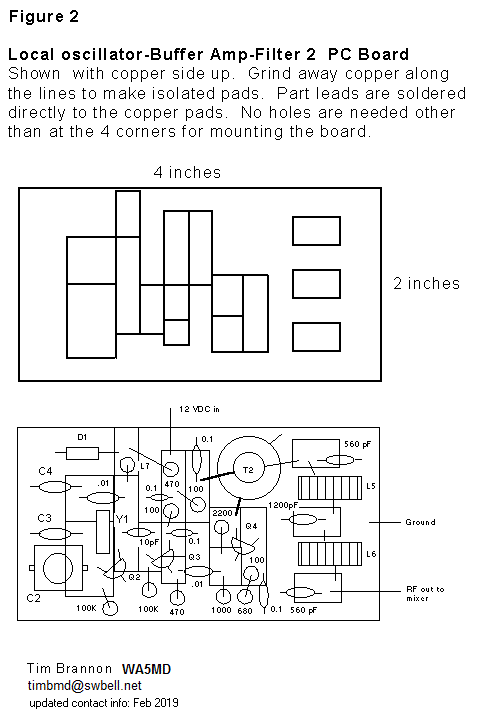
ConstructionThe converter can be built with a variety of techniques. For my prototypes, the mixer, diplexer, post-mixer amplifier, and Filter 1 were assembled on a 3" by 4½" perfboard. CAUTION: the pin numbers on the SBL-3 are NOT the same as an integrated circuit. Follow the pin connections on the schematic carefully. The oscillator and buffer amplifier, and Filter 2 can also be built on perfboard if frequency stability is not critical. However, I built the oscillator, buffer amp, and Filter 2 on a single-sided PC board using a modified "dead bug" technique. An arrangement of isolated copper pads was drawn on a 2" by 4" board using a felt-tip marker, and then a Dremel Moto-tool with a router bit was used to grind away the copper around the pads. This is a great method as you can make a PC board almost as fast as you can draw! No holes are needed--you just clean up the copper with an SOS pad, and solder the part leads directly to the copper pads. If you only have double-sided board available you'll have to etch away one side. Otherwise, stray capacitance between the two copper surfaces will make the oscillator unstable. I suggest assembling the local oscillator/buffer amp/Filter 2 first and verifying its proper operation and frequency. Leave some space on the board around crystal Y1. With some crystals small changes in the values of C3 or C4 might be needed so that you can set the frequency to exactly 4 MHz with the trimmer. Some extra room makes it easier to swap out capacitors. The 780 ohm R1 resistor in the emitter lead of Q4 is not a standard value but is instead made up with 100 ohm and 680 ohm resistors in series. The value of R1 was varied in 3 test models of the circuit and 780 ohms was found to most consistently yield +8 to +9 dBm of output power from Filter 2 when terminated in a 50 ohm load . This will give about 0.58 to 0.64 volts RMS when measured with an RF probe. To further enhance stability, the oscillator/buffer amp and Filter 2 can be enclosed in a small LMB or Radio Shack metal box with a phono jack for the RF output and a feed-thru capacitor for the power connection. I mounted the box on a plate of ¼" basswood to give it mechanical and thermal isolation from the chassis. Any similar material could be used for the mounting plate. The entire converter should be housed in a shielded metal cabinet with suitable RF connectors to prevent strong signals in the 4 MHz band from causing interference. Try to keep the coax between the oscillator/buffer amp and the mixer away from the components of Filter 1. This will minimize capacitive coupling of the strong LO signal directly into the converter input, and prevent degradation of the converter dynamic range. The shield at BOTH ends of this cable should be well grounded. The ferrite toroid cores used in T1 and T2 require some preparation before winding the coils. As they come from the factory the inside and outside edges are sharp and can nick the thin insulation on enameled wire. I first smooth the edges lightly with sand paper and then dip the cores for 2 coats in clear gloss polyurethane (from the hardware store). The powdered iron toroids used in the filters and diplexer are pre-coated and need no special preparation. Wire gauge is not critical, and Radio Shack carries a 3 spool pack of enameled wire in case you don't have any in your junk box. A few dabs of polystyrene Q-dope or similar compound can be used to secure the coils to the board when assembly is completed. Tune-up and OperationThe converter only draws about 30 mA at 13.8 VDC, but be sure to use a small fuse anyway. With the entire converter assembled, connect the input to a suitable LF antenna, and the output to your IF receiver with a short coaxial cable. With the receiver tuned to 4.000 MHz in CW mode, adjust C2 to give a peak signal just as you would tune in a CW station (turn down the RF gain during this procedure). This tunes the local oscillator to precisely 4.000 MHz, and thus controls the accuracy of the receiver frequency display at LF. Then, tune to a strong beacon signal in the middle of the band and adjust C1 for maximum signal strength. The setting of C1 is quite broad and it does NOT need to be peaked as you tune up and down the band. I tune up on 250 kHz and forget it! This is the only alignment that is needed. With the converter in operation you will receive 25 kHz to 600 kHz at 4025 kHz to 4600 kHz on your HF receiver. Some long-term drift in the LO frequency can be expected over time, and I compensate for this using the receiver RIT control. The converter is well-suited for use with active antennas, preamps, or loops which provide a low-impedance output. Random wire antennas will need some sort of matching network for best performance. When using an active antenna, be sure the power coupler does not place a DC voltage across the antenna input or you may destroy the mixer. When using a transceiver as the IF rig, take precautions to prevent transmitting a signal into the converter. ConclusionIf you already have a good HF receiver or transceiver that lacks strong LF coverage, this converter will give you top notch LF capabilities. There is no need to settle for mediocre performance if you are not satisfied with your present receiver. I would like to hear from everyone who builds the converter, and especially from those with ideas for improvements. Don't let parts availability slow you down. Write me if you have problems locating anything. Thanks to Ken Cornell for serving as my mentor via the Scrapbook series. Special thanks to Lyle Koehler for a review of the manuscript, invaluable (!) performance testing of the prototype, and suggestions for improvements. Part Suppliers
References1. DeMaw, D. and Rusgrove, J. "A High-Performance Low Frequency Converter". QST for June, 1977, pp 23-26. 2. Solid State Design for the Radio Amateur. Hayward, W., and DeMaw, D. ARRL, Newington, CT. 1986. Chapter 6. This article from The LOWDOWN is protected under US and international copyright laws. Please obtain the author's permission before redistributing this document or reproducing it in any other form. The HTML code and graphics files accompanying this article are property of the LWCA and must not be mirrored on any other server! Please refer to our Terms of Service, linked from the LWCA home page. |